|
|
Michel Calmet Faculté des Sciences du Sport Centre Universitaire de Recherche en Sciences de l'Education de Picardie Allée Paschal Grousset 80025 AMIENS cedex 1 - France |
Teaching judo, and to a wider extent, any combat physical activities in physical education courses:
How to fight against commonplaces.
|
|
Michel Calmet Faculté des Sciences du Sport Centre Universitaire de Recherche en Sciences de l'Education de Picardie Allée Paschal Grousset 80025 AMIENS cedex 1 - France |
The predominent logical characteristic is opposition ; am I supposed to reduce the Combat Physical Activities to that only and one dimension ?
The reference social practices (that gather around 1.5 million members) organize State Qualifications. These teaching qualifications require an ability to « act in opposition » and an other ability to « act in cooperation ». The CAPEPS (National Teaching Qualification in Physical Education) is the only diploma requiring an ability to « act in opposition ».
The results of a survey carried out on about 1000 people show that only the competitors are motivated by their results (to win competitions , to win medals).
|
Items |
|||||||
|
Educational Purpose |
Specific Objectives (Goals of maîtrise) (Goals of results) |
General objectives | |||||
| To learn to respect the others |
To learn technics so as to progress |
To pass belts |
To learn self-defense |
To win combats |
To win medals |
To keep fit | |
|
106 Judo teachers |
1 |
2 |
6 |
4 |
5 |
7 |
3 |
|
73 P.E. teachers |
1 |
2 |
6 |
3 |
5 |
7 |
4 |
|
238 1st year pupils |
2 |
3 |
4 |
1 |
4 |
5 |
5 |
|
45 young promising judoka competitors |
3 |
2 |
7 |
6 |
1 |
3 |
3 |
The « learned knowledge » in judo (Léziart 97) , acknowledged as such by experts since its origins , is based upon several items :
A knowledge based on combats (in competition or in training)
A knowledge based on Katas and technique.
A knowledge giving priority to self- defense.
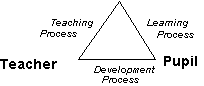
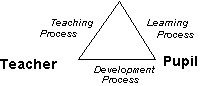
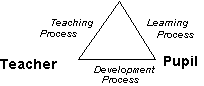
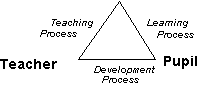
I f we take as a basis the educational triangle (Houssaye 1996) with its « learned knowledge » in judo, we can obtain the following tree :
|
Knowledge in Judo : Self-défense, Katas - Techniques, Randoris, shiaïs
|
||
|
Knowledge in CPA : |
||
|
Self-defense
|
Katas / Set techniques / Techniques
|
Randoris / Shiais / Combats in competition or in practice
|
This approach of these current PCAs drives us to say that a training to the CPAs must lead to a minimum of two « learned knowledges ». For instance :
In Aïkido : Self- defense, Katas/ Techniques.
In Judo and Karate : Self – defense, Katas / Techniques, Randoris / Shiaïs.
In Wrestling. : Techniques / Combats in competition or in training.
Do the pupils have to begin the practice of the CPAs with an on-the-ground or a standing up position ?
Is beginning with an on the ground combat activity at school a good way to switch onto new training prospects in the long run ?
Combatting in a standing up position means being «a grown –up ». « We are no longer little kids on all fours ! »
This means being confronted with the reality of all struggles (none begins lying on the ground).
Some authors, such as Bronchart in 1989, suggest a progression in Wrestling or in Sambo that starts with a lying on the mat position (on one’s stomach, on all fours, half way up and standing up) and to reach the standing up position is to be done within a period of 30 hours.
As far as Physical Education is concerned, a choice has to be made ; either teaching the throws with a safety guarantee or staying on the ground , at the risk of covering only a small part of the activity.
In Physical Education at school, floor practice in gymnastics is often a pretext to put aside the fact that there is an obvious lack of good quality combat mats. That recurring situation often overshadows a particular choice based on motivity and responsibility. It is sometimes a minimum choice, consisting in a few lessons based on floor exercises and the grouping of activities is therefore treated (or rather ill- treated) in the curriculum.
As far as the driving force is concerned, standing up combatting is aimed at building richer and more evolutive actions. This will enable the learner to manage his own calculated risks which will be the essential force for his training, provided the material and psychological conditions are good.
In the standing up position, the body joints such as the toes, the ankles and the knees will be set in action. The movements will have a larger span and the shifts will be smaller and more precise.
As far as the on the ground activity is concerned, the motivity is totally different. The movements are reduced, the center of gravity is lower and the body bearing is wider. This leads the judoka to an opposition based on strength with little control of the fall on the back.
In combats with the body standing half way up, the contestants are resting on their knees and on their feet. The orientation and action changes (forward / backward, right / left) will be executed without being able to move the bearing points in the proper direction.
The two contestants being in a steady position , one will try to throw the other as follows :
By an attempt to surpass the other’s opposition with strength.
This is not really prejudicial but it is to the detriment of the understanding of the two contestants’ balance.
By throwing one’s own body , thus sacrificing one’s own balance so as to improve the efficiency of the falling down on the mats.
He no longer learns to keep his balance to insure the control of his opponent’s fall. At that very moment, the judoka in the position of falling is going to stretch his arm and put his hand on the mat so as to find his balance back.
In that half way up body position (decided for safety reasons, considering the falls), the contestants often tend to grasp each other around the head with the intention of getting a closer contact. The priority given to strength as described above is generally bad for the neck joints.
To begin with the on the ground activity is, in a way ,brushing the problems aside. Indeed, the movements, the contacts are different from those of the standing up activity and furthermore they may be more « intimate » and at the origin of psychological problems. The question is when and how to switch onto the standing up activity after one or even several on the ground training sessions. Would the learning of the falls be activated ,as it is not necessary in the on the ground activity ? Naturally, self control, the respect of the rules and of the specific movements will be acquired. But many other points will have to be taken into consideration, such as the falls, the throws, the fact that the falling judoka will try to stretch his arm onto the mat or that the other judoka will
throw his body into his action. At that stage, the risks are major for beginners of CPA activities.
In a standing up practice, the beginners will have to keep their balance and control their opponents’ fall to see their proficiency in action.
It appears to us that a more promising way of working would reside in a practice giving greater importance to a progression from a standing up combat to an eventual on the ground practice.
How is it possible to explain to a pupil that he is running a danger during a P.E lesson at 2.00pm while practising judo in a standing up position, and that he no longer is at 7.00 pm at his club ?
As far as snow classes are concerned, their specific aims could as well be summed up in just learning how to slide on the snow. And yet, who dares beginning the development of the ski skills with some tobogganing lessons because of the risks of falling down?
Are the weight, skill and tonicity categories the only methods to organise the confrontation ?
If the Olympic kind of confrontation still prevails on the educational choices, a preparation by categories will be required to organize the constitution of the groups.
What might happen is a level opposition between the two contestants, thus leading to a mutual neutralization.
Moreover, the time of combat is short, about one minute. This prevents exhaustion and many risks during an intense confrontation but that shortens any tactical analysis.
Usually, the common solution consists in differentiating the functions of the contestants by giving some rights to the first one and restraints to the second one. How is it possible to set up these functions when the combat experience may be less than ten hours ?
In a club, the beginner (who sometimes starts the activity in the middle of the year) is often confronted with a more experienced judoka. Many guarantees are provided, such as a better control of the actions from the experienced judoka, a higher benevolence towards the beginner or an explanation of what is going on ; in a word, a mutual training.
In P.E, the free choice of one’s partner will provide combats in which co-operation will become necessary. Indeed, the pupils will have to work together again and again, and that very co-operation will enable them to study progressively how both are working, and therefore, how I can manage to bring my actions to success.
More than the results themselves, the comprehension of an action in an arranged opposition seems the target to reach (in a competition pool, less than 50% of the competitors win more than 50% of their combats). The interruption of the opposition, the obligation to do what has been done successfully again are two means of immersing oneself in an experience or a solution. In an opposition based on a free choice with the partner, the two pupils are entitled to the same rights and both will try to find a way to understand (or try to understand) how to prepare one’s body as a means of throwing one’s opponent.
The pupils have problems with turning their backs for an attack ; can they still progress ?
Turning one’s back for a throw is a complex motor job. Above all, it requires a change in the feet position. What is characteristic with the beginners is the opposition they provide by pushing forward with both feet almost set on one line (Pic. 1).
|
Pic. 1 |
Pic. 2 |
One leg is resisting at the back while the front one is mobile for action, thus activating the beginning of the movement. The attacking partner shifts his front foot and finds himself in an unsteady position (with his feet almost crossed) in front of his opponent (Pic. 2). He only has to stretch his leg across and lean forward for a final throw. After a few unsuccessful attempts it seems easier to wait until the other partner’s movement so as to "get the upper hand".
The adaptation to new rules seems more important than differentiating the functions of the contestants. The obligation to keep one’s balance during the throw makes the action described above impossible to achieve. The partner being attacked will find himself obliged to find solutions to either dodge the attack (repeated attacks will then be seen) , or to control that attack and anticipate it by moving the hip forward in an attempt of a throw. The developed skill is essentially the action of the hip to dodge or counter attack.
Conclusion
The internal logic of the activity will enable us to define working situations specific to the CPAs. We must not forget the logic of the progression in the activity. The few hours of combat activities allotted to PE must not be blinded by the mediatization of one part of that activity: high level competition.
The rules must be adjusted as much as on the form (the restraints to respect) as on the substance ("who am I confronted with?"). Beginning with either an on the ground or standing up activity must remain an educational
alternative but the developed skills in either fields don’t seem to be fit for use up again in a short term.
Bibliographie :
Bourreau A, (1997), Le judo dans le système éducatif, Dojo-info 9, 2.
Bronchart B. 1989 L'enseignement des sports de combat, Amphora p. 79-100
Bui-Xuan G. (1994), Une modélisation du procès pédagogique. Enseigner l'EPS, AFRAPS, 77-89.
Calmet M. Gouriot M., (1987), Didactique judo en milieu scolaire, CDDP Beauvais.
Calmet M. Patinet C. (1993), Duos-duels, EP.S 239, 64-67.
Calmet M., (1999) , Enseigner le judo ou le savoir combattre, communication affichée, Colloque international de l'AIESEPS, Besançon.
Davisse A. (1996), Filles et Garçons. Ce qui s'apprend en EPS, SNEP, 100-104.
Famose JP, (1990), Apprentissage moteur et difficulté de la tâche, EPS INSEP
Graham G, (1999) The role of physical education in guiding youngsters to become physically active and healthy for a lifetime, Main lectures, 7th International congress on physical education and sport, Komotini.
Houssaye J., (1996), Les trois facettes de la motivation, Sciences humaines HS 12, 47.
Léziart Y., (1997), Savoir savant et transposition didactique. STAPS 42, 59-71.
Martinand JL., in Astolfi JP. et Develay M., (1991), La didactique des Sciences, QSJ 2448, PUF.
Rink J, (1999) What do people learn from physical activity programs, Cagical lecture, Congrès International de l'AIESEP, Besançon.
Terrisse A, (1996), Analyse de la transposition didactique du judo : évolution du "savoir combattre" dans l’enseignement du judo à l’école à travers la revue EPS de 1950 à 1993, Revue Française de Pédagogie 116, 65-75.
Terrisse A, Sauvegrain JP, (1998), Identification des difficultés d'appropriation du "savoir lutter" par une méthode d'ingénierie didactique, Sciences et motricité 32-33, 74-87.
Terrisse A. et col., (2000), Recherche en sports de combat et en arts martiaux : état des lieux, EP.S, Paris, France.