|
Fig. 1 |
Fig. 2 |
Stéphanie Rabas, Sandrine Duflos, Michel Calmet, Saïd Ahmaïdi
Faculté des Sciences du Sport
Résumé (fourni par les auteurs) :
L'objet d'étude de la
présente investigation est de rendre compte du système d'attaque des judokas
lors des compétitions.
Nous avons choisi
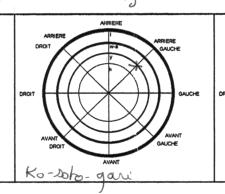
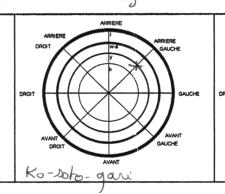
d'observer les judokas par un système de "cibles" qui permet de
relever les valeurs et les directions de projection lorsque les judokas
marquent un avantage pendant des combats (Fig. 1). Cette étude, réalisée lors
de compétitions scolaires et universitaires, porte sur 66 sujets: 51 en UNSS et
15 en FNSU.
|
Fig. 1 |
Fig. 2 |
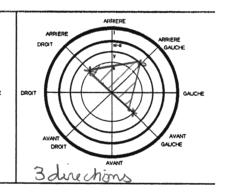
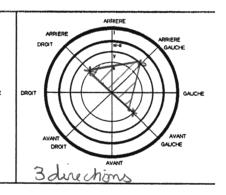
Chaque combat faisant
l'objet d'une cible, l'ensemble des données relevées pour chaque compétiteur a
été ensuite retranscrit sur un seul schéma (Fig. 2). Nous avons pu de ce fait
déterminer un nombre moyen de directions d'attaque et voir si il existait un ou
plusieurs triangles d'attaque, facteur d'incertitude chez l'adversaire. Les
données ont été répertoriées suivant les catégories d'âge et de grade. Les 66
sujets observés ont fait en moyenne trois combats (3.17 ± 0.67). En s'appuyant sur la
progression officielle de la fédération française de judo, nous pensions
atteindre une moyenne de directions au moins égale à trois chez les ceintures
marrons. Cet objectif est quasiment atteint pour les ceintures oranges et
vertes, la moyenne étant de 2.71 ± 1.38 avec 7 sujets (ce qui correspondrait à l'acquisition des balances
avant-arrière et arrière-avant), les ceintures marrons s'en éloignent (1.89 ± 0.78 pour 9 sujets), les ceintures noires
reviennent à ce niveau (3.20 ± 0.96 pour 15 sujets).
La diminution du nombre
des directions d'attaque chez les ceintures marrons pourrait s'expliquer par
une phase de maturation stratégique. Un certain temps d'adaptation semblerait
nécessaire afin de maîtriser, en compétition, les techniques apprises
précédemment.
Afin d'approfondir ce
sujet, nous pensons:
- poursuivre ce travail
en incluant le kumi-kata et la direction d'attaque dans le relevé des données.
- développer une
recherche sur les contenus mis en place dans les clubs et se rendre compte de
l'importance accordée au travail de contextualisation des techniques (exercices
à thème spécifiques au judo avec des tâches de type yaku-soku-geiko).
Mots clefs:
judo, système d'attaque,
compétition, profil de judoka, investigation quantitative
Contacts:
Faculté des Sciences du
Sport
Allée Pascal Grousset
80025 Amiens cedex 1
michel.calmet@ca.u-picardie.fr
Stéphanie Rabas, Sandrine Duflos, Michel Calmet, Saïd Ahmaïdi
Faculté des Sciences du Sport
Abstract
(translate) :
The goal of the present investigation is to give back the attack system of judokas during competitions.
We have chosen to observe the judokas by a system of "targets" that allows to notice values and directions of projection when the judokas obtain an advantage during fights (Fig. 1). This study, realized during university and scholastic competitions, focuses on 66 subjects : 51 in UNSS (scholastic competitions) and 15 in FNSU (university competitions).
|
Fig. 1 |
Fig. 2 |
Each fight being a target, the totality of data noticed for each competitor has been then retranscribed on an alone diagram (Fig. 2). We have been able thereby to determine an average number of directions of attack and to see if it existed an or several triangles of attack, factor of uncertainty for the opponant. Data have been listed following age and rank categories. 66 observed subjects have made on the average three combats (3.17 ± 0.67). By leaning on the official progression of the French judo federation, we were thinking to reach an average of at least three directions at brown belts. This objective is nearly reached for green and orange belts, the average being 2.71 ± 1.38 with 7 subjects (what would correspond to the acquisition of balances forward -backward and backward - foreward), brown belts distance some (1.89 ± 0.78 for 9 subjects), black belts return at this level (3.20 ± 0.96 for 15 subjects). The diminution of the number of directions of attack at brown belts could have explain by a strategic maturation phase. A time of adaptation would seem necessary so as to succeed in doing during competition, learnt techniques previously.
So to follow this study, we think:
- to continue this work by including the kumi-kata and the direction of attack in the statement of data.
- to develop a research on contents taught in clubs and to account for the importance granted to the work of contextualisation of techniques (with thematic exercises specific to judo with tasks of type yaku-soku-geiko).
Key
words:
judo, attack system of, competition, judoka's profile, quantitative investigation